
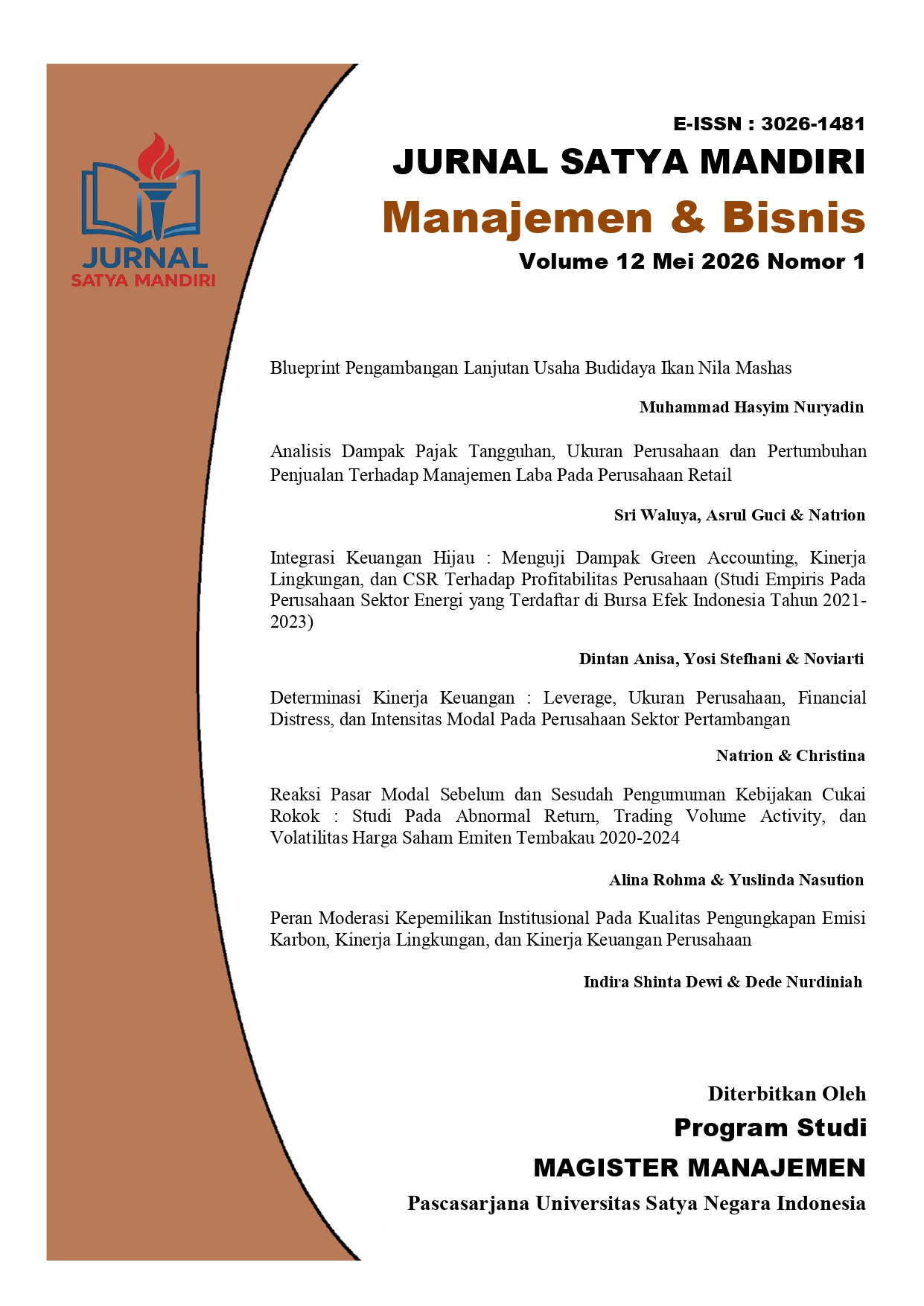
THE MODERATION ROLE OF INSTITUTIONAL OWNERSHIP ON THE QUALITY OF CARBON EMISSION DISCLOSURE, ENVIRONMENTAL PERFORMANCE AND CORPORATE FINANCIAL PERFORMANCE
DOI:
https://doi.org/10.54964/satyamandiri.v12i1.684Abstract
ABSTRACT
This study aims to examine the impact of the quality of carbon emissions disclosure and environmental performance on financial performance, with institutional ownership as a moderating variable. This study employs a quantitative approach and panel data regression. It analyses companies listed in Indonesia between 2020 and 2025 that publish sustainability reports and comply with the PROPER system. The results indicate that the quality of carbon emissions disclosure has a significant negative impact on financial performance. Environmental performance does not have a significant direct impact. Institutional ownership significantly strengthens the relationship between the quality of carbon emissions disclosure and financial performance. Conversely, institutional ownership weakens the relationship between environmental performance and financial performance. These findings suggest that institutional ownership acts as a heterogeneous moderator. The uniqueness of this study lies in the development of carbon emissions disclosure quality as a multidimensional construct encompassing completeness, accuracy, independent verification, and strategic integration. This study also positions institutional ownership as a complementary resource whose moderating effect is not always positive. Unlike previous studies that assumed consistent moderation, this study demonstrates that institutional ownership can either strengthen or hinder the economic conversion of various environmental capabilities. The implications of this study suggest that companies need not only to improve carbon disclosure and environmental activities but also to consider the characteristics of institutional investors, who may be short-term oriented, thereby conflicting with long-term environmental investments.
Keywords: Quality of carbon emissions disclosure, Environmental performance, Financial performance, Institutional ownership
References
Aguilera, R. V., Bermejo, V., Capapé, J., & Cuñat, V. (2021). The systemic influence of foreign institutional investors on corporate governance: Evidence from shareholder proposals. Journal of International Business Studies, 52(8), 1531–1560. https://doi.org/10.1057/s41267-021-00426-5
Alsayegh, M. F., Abdul Rahman, R., & Homayoun, S. (2020). Corporate economic, environmental, and social sustainability performance transformation through ESG disclosure. Sustainability, 12(9), 3910. https://doi.org/10.3390/su12093910
Barney, J. (1991). Firm resources and sustained competitive advantage. Journal of Management, 17(1), 99–120. https://doi.org/10.1177/014920639101700108
Broadstock, D. C., Chan, K., Cheng, L. T. W., & Wang, X. (2020). The role of ESG performance during times of financial crisis: Evidence from COVID-19 in China. Finance Research Letters, 38, 101716. https://doi.org/10.1016/j.frl.2020.101716
Chen, T., Dong, H., & Lin, C. (2020). Institutional shareholders and corporate social responsibility. Journal of Financial Economics, 135(2), 483–504. https://doi.org/10.1016/j.jfineco.2019.06.007
Choi, B. B., Lee, D., & Psaros, J. (2013). An analysis of Australian company carbon emission disclosures. Pacific Accounting Review, 25(1), 58–79. https://doi.org/10.1108/01140581311318968
Clarkson, P. M., Li, Y., Richardson, G. D., & Vasvari, F. P. (2018). Revisiting the relation between environmental performance and environmental disclosure: An empirical analysis. Accounting, Organizations and Society, 33(4–5), 303–327. https://doi.org/10.1016/j.aos.2007.05.003
Connelly, B. L., Certo, S. T., Ireland, R. D., & Reutzel, C. R. (2011). Signaling theory: A review and assessment. Journal of Management, 37(1), 39–67. https://doi.org/10.1177/0149206310388419
Dhaliwal, D. S., Li, O. Z., Tsang, A., & Yang, Y. G. (2011). Voluntary nonfinancial disclosure and the cost of equity capital: The initiation of corporate social responsibility reporting. Accounting Review, 86(1), 59–100. https://doi.org/10.2308/accr.00000005
Dowling, J., & Pfeffer, J. (1975). Organizational legitimacy: Social values and organizational behavior. Pacific Sociological Review, 18(1), 122–136.
Dyck, A., Lins, K. V., Roth, L., & Wagner, H. F. (2019). Do institutional investors drive corporate social responsibility? International evidence. Journal of Financial Economics, 131(3), 693–714. https://doi.org/10.1016/j.jfineco.2018.08.013
Freeman, R. E. (1984). Strategic Management: A Stakeholder Approach. Pitman.
Fujii, H., Iwata, K., Kaneko, S., & Managi, S. (2013). Corporate environmental and economic performance of Japanese manufacturing firms: Empirical study for sustainable development. Business Strategy and the Environment, 22(3), 187–201. https://doi.org/10.1002/bse.1747
Hart, S. L. (1995). A natural-resource-based view of the firm. Academy of Management Review, 20(4), 986–1014. https://doi.org/10.5465/amr.1995.9512280033
Hartzell, J. C., & Starks, L. T. (2003). Institutional investors and executive compensation. Journal of Finance, 58(6), 2351–2374. https://doi.org/10.1046/j.1540-6261.2003.00608.x
He, F., Du, H., & Yu, B. (2022). Corporate ESG performance and manager misconduct: Evidence from China. International Review of Financial Analysis, 82, 102201. https://doi.org/10.1016/j.irfa.2022.102201
Jensen, M. C., & Meckling, W. H. (1976). Theory of the firm: Managerial behavior, agency costs and ownership structure. Journal of Financial Economics, 3(4), 305–360. https://doi.org/10.1016/0304-405X(76)90026-X
Khalil, M., Khalil, R., & Sarea, A. (2024). Carbon disclosure quality, climate risk premium, and firm value: Evidence from international markets. Journal of Cleaner Production, 434, 139950. https://doi.org/10.1016/j.jclepro.2023.139950
Li, Z., Liao, G., & Albitar, K. (2019). Does corporate environmental responsibility engagement affect firm value? The mediating role of corporate innovation. Business Strategy and the Environment, 29(3), 1045–1055. https://doi.org/10.1002/bse.2416
Liang, H., & Renneboog, L. (2017). On the foundations of corporate social responsibility. Journal of Finance, 72(2), 853–910. https://doi.org/10.1111/jofi.12487
Luo, L., Lan, Y. C., & Tang, Q. (2019). Corporate incentives to disclose carbon information: Evidence from the CDP Global 500 report. Journal of International Financial Management & Accounting, 23(2), 93–120.
Matsumura, E. M., Prakash, R., & Vera-Muñoz, S. C. (2014). Firm-value effects of carbon emissions and carbon disclosures. Accounting Review, 89(2), 695–724. https://doi.org/10.2308/accr-50629
Mitchell, R. K., Agle, B. R., & Wood, D. J. (1997). Toward a theory of stakeholder identification and salience: Defining the principle of who and what really counts. Academy of Management Review, 22(4), 853–886.
Otoritas Jasa Keuangan. (2017). Peraturan OJK Nomor 51/POJK.03/2017 tentang Penerapan Keuangan Berkelanjutan bagi Lembaga Jasa Keuangan, Emiten, dan Perusahaan Publik. OJK.
Plumlee, M., Brown, D., Hayes, R. M., & Marshall, R. S. (2020). Voluntary environmental disclosure quality and firm value: Further evidence. Journal of Accounting and Public Policy, 34(4), 336–361. https://doi.org/10.1016/j.jaccpubpol.2020.04.004
Qian, W., & Schaltegger, S. (2017). Revisiting carbon disclosure and performance: Legitimacy and management views. British Accounting Review, 49(4), 365–379. https://doi.org/10.1016/j.bar.2017.05.005
Ross, S. A. (1977). The determination of financial structure: The incentive-signalling approach. Bell Journal of Economics, 8(1), 23–40.
Russo, M. V., & Fouts, P. A. (1997). A resource-based perspective on corporate environmental performance and profitability. Academy of Management Journal, 40(3), 534–559.
Saka, C., & Oshika, T. (2014). Disclosure effects, carbon emissions and corporate value. Sustainability Accounting, Management and Policy Journal, 5(1), 22–45.
Serafeim, G., & Yoon, A. (2023). Which corporate ESG news does the market react to? Financial Analysts Journal, 79(1), 59–78. https://doi.org/10.1080/0015198X.2022.2145697
Setia-Atmaja, L., Tanewski, G. A., & Skully, M. (2009). The role of dividends, debt and board structure in the governance of family controlled firms. Journal of Business Finance & Accounting, 36(7–8), 863–898.
Shleifer, A., & Vishny, R. W. (1986). Large shareholders and corporate control. Journal of Political Economy, 94(3), 461–488. https://doi.org/10.1086/261385
Spence, M. (1973). Job market signaling. Quarterly Journal of Economics, 87(3), 355–374.
Suchman, M. C. (1995). Managing legitimacy: Strategic and institutional approaches. Academy of Management Review, 20(3), 571–610.
Surroca, J., Tribó, J. A., & Waddock, S. (2010). Corporate responsibility and financial performance: The role of intangible resources. Strategic Management Journal, 31(5), 463–490. https://doi.org/10.1002/smj.820
Task Force on Climate-related Financial Disclosures. (2017). Recommendations of the Task Force on Climate-related Financial Disclosures. TCFD.
Trumpp, C., & Guenther, T. (2017). Too little or too much? Exploring U-shaped relationships between corporate environmental performance and corporate financial performance. Business Strategy and the Environment, 26(1), 49–68. https://doi.org/10.1002/bse.1900
Wahyudi, U., & Pawestri, H. P. (2006). Implikasi struktur kepemilikan terhadap nilai perusahaan dengan keputusan keuangan sebagai variabel intervening. Simposium Nasional Akuntansi IX, Padang.
Zahid, R. M. A., Khan, M. K., Anwar, W., & Maqsood, U. S. (2020). The role of audit quality in the ESG-corporate financial performance nexus: Empirical evidence from Western European companies. Borsa Istanbul Review, 22(1), S200–S212.
Zhang, M., Ma, L., Su, J., & Zhang, W. (2021). Do suppliers applaud corporate social performance? Journal of Business Ethics, 168(1), 1–15. https://doi.org/10.1007/s10551-019-04321-8
Downloads
Published
How to Cite
Issue
Section
License
Copyright (c) 2026 Jurnal Satya Mandiri Manajemen dan Bisnis

This work is licensed under a Creative Commons Attribution-NonCommercial-ShareAlike 4.0 International License.